EMT Practice Test

1. Question Content...


Question List

Question1: Which of the following statements about the shift-left approach is true?

Question2: Which of the following statements about TDD, BDD and ATDD is TRUE?

Question3: Which of the following statements best describes the way in which decision coverage is measured?

Question4: Which of the following statements about retrospectives is TRUE?

Question5: Consider the following examples of risks identified in different software development projects:
[I]. The contrast color ratio for both normal text and large text of a website does not comply with the applicable accessibility guidelines, making it difficult for many users to read the content on the pages
[II]. A development vendor fails to deliver their software system on time, causing significant delays to system integration testing activities that have been planned as part of a development project for a system of systems
[III]. People in the test team do not have sufficient skills to automate tests at the test levels required by the test automation strategy which does not allow production of an effective regression test suite
[IV]. In a web application, data from untrusted sources is not subject to proper input validation, making the application vulnerable to several security attacks Which of the following statements is true?
Question6: The fact that defects are usually not evenly distributed among the various modules that make up a software application, but rather their distribution tend to reflect the Pareto principle:

Question7: Which of the following statements best describes how configuration management supports testing?

Question8: Which of the following statements is true?

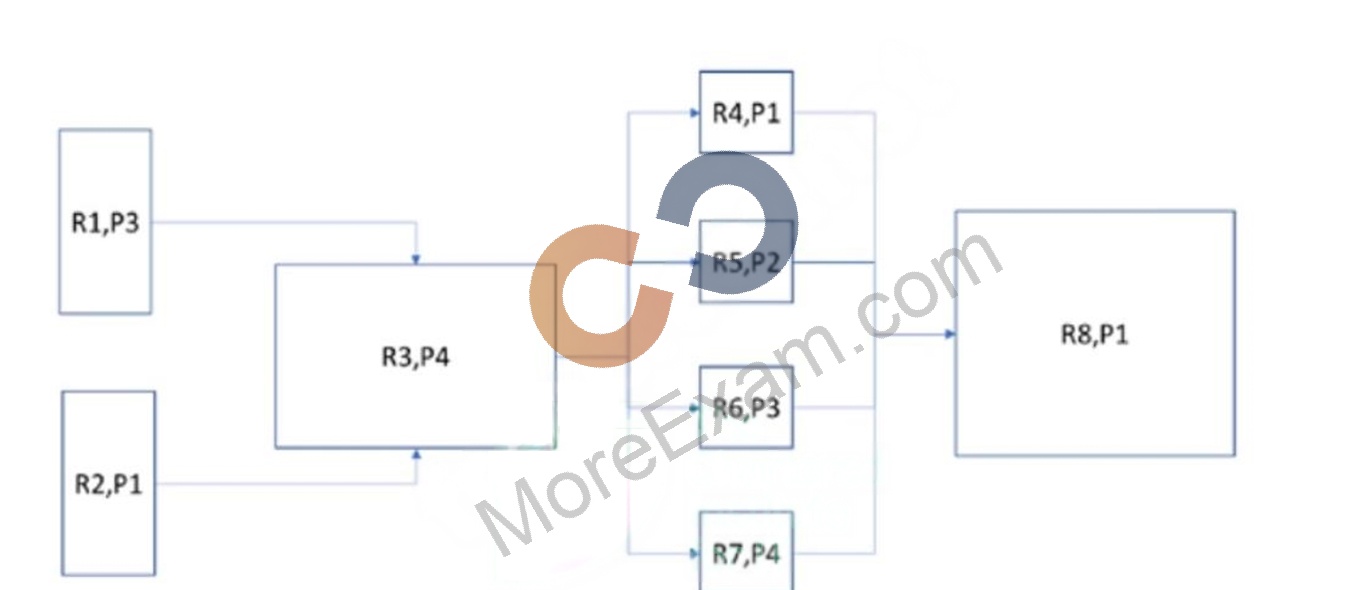
Question9: The following diagram displays the logical dependencies between requirements and the individual requirement priorities. For example, "R2->R3" means that R3 is dependent on R2. Priority is indicated by the number next to the letter "P" i.e. P1 has a higher priority than P2.

Which one of the following options best describes the test execution sequence using both requirement dependency and priority

Question10: Select the roles required in a formal review:

Question11: Which of the following is a task the Author is responsible for, as part of a typical formal review?

Question12: Which of the following statements about static testing and dynamic testing is true?

Question13: The acceptance criteria associated with a user story:

Question14: Which of the following statements about error guessing is true?
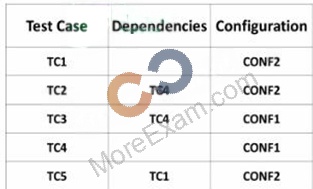
Question15: For each test case to be executed, the following table specifies its dependencies and the required configuration of the test environment for running such test case:

Assume that C0NF1 is the initial configuration of the test environment Based on this assumption, which of the following is a test execution schedule that is compatible with the specified dependencies and allows minimising the number of switches between the different configurations of the test environment^

Question16: The following rules determine the annual bonus to be paid to a salesman of a company based on the total annual amount of the sales made (referred to as TAS).
If the TAS is between 50k€ and 80k€, the bonus is 10%. If the TAS exceeds 80k€ by a value not greater than 40k€, the bonus is 15%. Finally, if the TAS exceeds the maximum threshold which entitles to a 15% bonus, the bonus is 22%.
Consider applying equivalence partitioning to the TAS (Note: 1k€ = 1000 euros).
Which one of the following answers contain only test cases that belong to the same equivalence partition?

Question17: A test manager decided to skip static testing since he believes bugs can be found easily by doing dynamic testing. Was this decision right or wrong?

Question18: Select which of the following statements describe the key principles of software testing?
i. Testing shows the presence of defects, not their absence.
ii . Testing everything Is possible.
iii . Early testing Is more expensive and is a waste of time.
iv . Defects cluster together.
v. Testing is context dependent.
vi. Beware of the pesticide paradox.
vii . Absence of errors is a fallacy.
Select the correct answer:

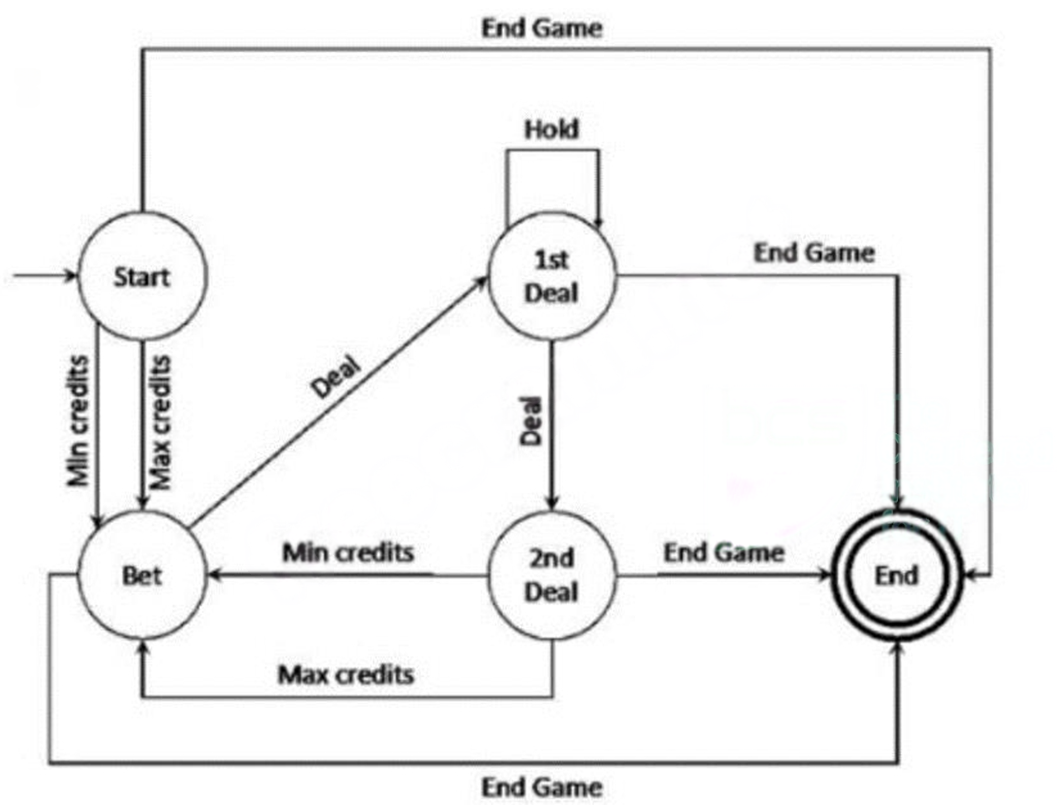
Question19: Consider the following simplified version of a state transition diagram that specifies the behavior of a video poker game:

What Is the minimum number of test cases needed to cover every unique sequence of up to 3 states/2 transitions starting In the "Start" state and ending In the "End" state?

Question20: From a testing perspective, configuration management

Question21: Which of the following characterizations applies to a test tool used for the analysis of a developer's code prior to its execution?

Question22: Which of the following is a factor that contributes to a successful review?

Question23: A typical objective of testing is to

Question24: Consider a given test plan which, among others, contains the following three sections: "Test Scope", "Testing Communication", and "Stakeholders". The features of the test object to be tested and those excluded from the testing represent information that is:

Question25: Which of the following statements about the value of maintaining traceability between the test basis and test work products is not true?

Question26: You are testing the latest version of an air-traffic control system prior to production deployment using exploratory testing. After following an unusual sequence of input steps, the system crashes. After the crash, you document a defect report with the following information:
* Title: System crashes unexpectedly during input.
* Brief summary: System crashes when an unusual sequence of inputs is used.
* Version: V1.001
* Test: Exploratory testing prior to production deployment
* Priority: Urgent
* Risk: High
* Reference: Screenshot of crashed application
What critical Information Is missing from this report?

Question27: To be able to define testable acceptance criteria, specific topics need to be addressed. In the table below are the topics matched to an incorrect description. Match the topics (the left column) with the correct description (the right column) Topic Description A: Functional behaviour A: How the system performs the specific behaviour.
8: Quality characteristics B: A sequence of actions between an external actor and the system, to accomplish a specific goal or business task.
C: Scenarios C: The externally observable behaviour with user actions as input operating under certain configurations.
D: Business rules D; Description of the connections between the system to be developed and the outside world.
E: External interfaces E: Activities that can only be performed in the system under certain conditions defined by outside procedures and constraints.

Question28: You are an experienced tester on a project with incomplete requirements and under pressure to deploy.
What type of testing should you do?

Question29: Which of the following best describes the way in which statement coverage is measured?

Question30: For the same financial institution in Question 12, with the same requirements and expectations, what would be the most likely investment values used in testing if two-point boundary value analysis is used to design test cases specific to the 13% interest rate equivalence partition?

Question31: Determining the schedule for each testing activity and test milestones for a test project, using activity estimates, available resources, and other constraints is a typical task performed during

Question32: A document descnbes the test procedures that have been derived for the identified test sets Among other things, the order in which the test cases in the corresponding test set are to be executed according to the dependencies described by preconditions and postconditions is specified This document is a typical work product produced as part of:

Question33: Which of the following is not an example of a typical generic skill required for testing?

Question34: During iteration planning, a scrum team uses an estimation technique called planning poker to estimate the effort required to deliver a critical user story. In advance of the estimation session, the team agreed on some ground rules to limit the number of poker rounds and save time.
The team agreed on the following:
1. They will use the following progression for estimation: Extra-small, Small, Medium, Large, Extra-large, and Extra-extra-large.
2. If estimation values differ significantly, the highest score will be used for estimation purposes.
The result of the first round of planning poker:
Team Member Estimation
Business Large
Development Extra-extra-large
Testing Extra-extra-large
Which of the following options best represent the team's next actions?

Question35: Which statement is true regarding confirmation testing and regression testing?

Question36: Mark the correct sentences:
* Defects are a result of environmental conditions and are also referred to as "Failures"
* A human mistake may produce a defect
* A system mil totally fail to operate correctly when a failure exists in it
* When a defect exists in a system it may result in a failure
* Defects occur only as a result of technology changes

Question37: Which of the following statements refers to good testing practice to be applied regardless of the chosen software development model?

Question38: Which of the following statements is not correct?

Question39: Which of the following about typical information found within a test plan is FALSE?

Question40: Which of the following statements about the shift-left approach is true?
Question41: Who of the following has the best knowledge to decide what tests in a test project should be automated?

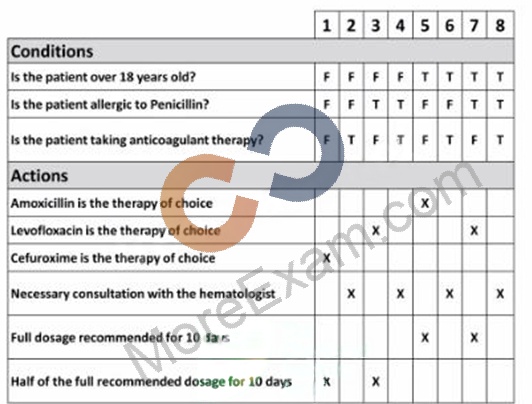
Question42: The following decision table is used to assist a doctor in determining the drug therapy to prescribe for a patient (aged 6 to 65 years) diagnosed with acute sinusitis. The table consists of three Boolean conditions and six actions

Based only on the given information, which of the following statements is TRUE?

Question43: Which of the following coverage criteria results in the highest coverage for state transition based test cases?

Question44: Which of the following is a test-first approach, where tests that express a shared understanding from stakeholders of how the application is expected to work, are first written in business-readable language (following the Given/When/Then format), and then made executable to drive development?

Question45: Which of the following is an advantage of the whole team approach?

Question46: Which sequence of stated in the answer choices is correct in accordance with the following figure depicting the life-cycle of a defect?

Question47: Atypical generic skill required for the role of tester is the ability to

Question48: Which of the following statements about statement coverage is TRUE?

Question49: Which of the following statements best describe Behavior-Driven Development (BDD)?

Question50: Which one of the following is a typical entry criteria for testing?

Question51: You are testing a room upgrade system for a hotel. The system accepts three differed types of room (increasing order of luxury): Platinum. Silver and Gold Luxury. ONLY a Preferred Guest Card holder s eligible for an upgrade.
Below you can find the decision table defining the upgrade eligibility:

What is the expected result for each of the following test cases?
Customer A: Preference Guest Card holder, holding a Silver room
Customer B: Non Preferred Guest Card holder, holding a Platinum room

Question52: What is test oracle?

Question53: Can "cost" be regarded as Exit criteria?

Question54: Which of the following statements are true?
1. Early and frequent feedback helps to avoid requirements misunderstanding.
2. Early feedback allows teams to do more with less.
3. Early feedback allows the team to focus on the most Important features.
4. Early and frequent feedback clarifies customer feedback by applying static testing techniques Select the correct answer:

Question55: Which of the following statements about branch coverage is true?

Question56: In addition to thorough testing of the requirements specification, a development team aims to involve users as early as possible in the development process, using practices such as prototyping, to ensure that the software systems being developed will meet the users' expectations. This approach is especially useful at mitigating the risks associated with one of the seven testing principles, which one?

Question57: Which of the following s the most correct statement about state testing techniques?

Question58: Testing Quadrants, as a model, is effective in aligning stakeholders within Agile teams.
Which of the following examples demonstrates this?

Question59: Consider a review for a high-level architectural document written by a software architect. The architect does most of the review preparation work, including distributing the document to reviewers before the review meeting. However, reviewers are not required to analyze the document in advance, and during the review meeting the software architect explains the document step by step. The only goal of this review is to establish a common understanding of the software architecture that will be used in a software development project.
Which of the following review types does this review refer to?

Question60: Which one of the following statements correctly describes the term 'debugging'?

Question61: Which one of the following statements relating to the benefits of static testing is NOT correct?

Question62: Confirmation testing is performed after:

Question63: Following a risk-based testing approach you have designed 10 tests to cover a product risk with a high-risk level. You want to estimate, adopting the three-point test estimation technique, the test effort required to reduce the risk level to zero by executing those 10 tests. You made the following three initial estimates:
* most optimistic = 6 person hours
* most likely = 30 person hours
* most pessimistic = 54 person hours
Based only on the given information, which of the following answers about the three-point test estimation technique applied to this problem is true?

Question64: Match each objective to the correct test level
Objective:
A) Verifying whether the functional and non-functlonal behaviors of the system are as designed and specified.
B) Verifying whether the functional and non-functlonal behaviors of the interfaces are as designed.
C) Verifying whether the functional and non-functional behaviors of the components are as designed and specified.
D) Establishing confidence in the quality of the system as a whole.
Test Level:
1. Component testing.
2. Integration testing.
3. System testing.
4. Acceptance testing.

Question65: Which of the following statements is true?

Question66: Which of the following work products cannot be examined by static analysis?

Question67: For each of the test cases to be executed, the following table specifies the priority order and dependencies on other test cases

Which of the following test execution schedules is compatible with the logical dependencies and allows executing the test cases in priority order?

Question68: Which of the following is not an example of a typical content of a test completion report for a test project?

Question69: Metrics can be collected during and at the end of testing activities to assess which of the following?
i. Progress against the planned schedule and budget.
II . Current quality of the test object.
Hi. Adequacy of the test approach.
iv . Effectiveness of the test activities with respect to the objectives.
v. All the above.
Select the correct answer:

Question70: You are testing a system that is used in motor vehicles to warn the driver of an obstacle when re-versing. Output is provided by a series of LED lights (green, yellow, and red), each illuminated based on clearly defined conditions.
The following summary describes the functionality:
* Object within 10 metres, green LED lit.
* Object within 5 metres, yellow LED lit.
* Object within 1 metre, red LED lit.
* Setting sensitivity mode to "ON" will result in only the red LED being lit when the object is within 1 metre.
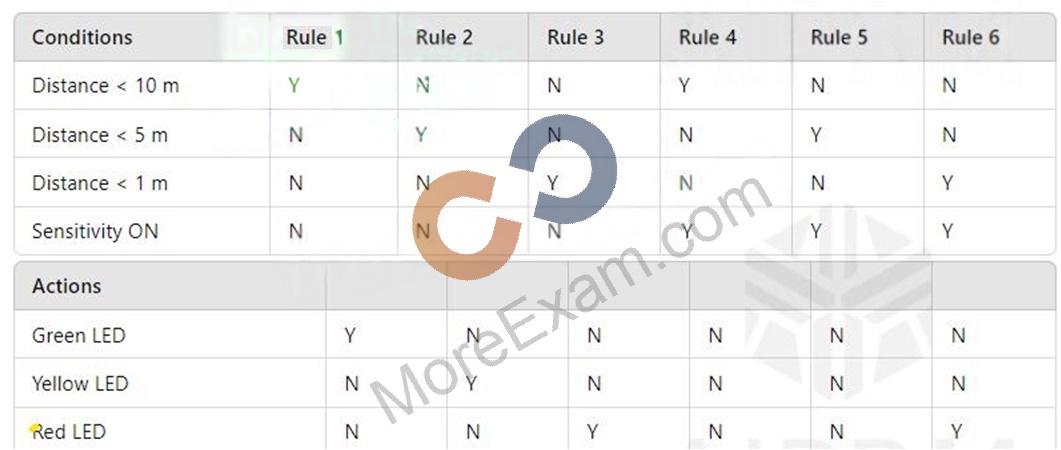
The following decision table describes the rules associated with the functioning of this proximity warning system:

Which intended functionality is tested by Rule 5 in the decision table?

Question71: Which of the statements correctly describes when a whole team approach may NOT be suitable?

Question72: An alphanumeric password must be between 4 and 7 characters long and must contain at least one numeric character, one capital (uppercase) letter and one lowercase letter of the alphabet.
Which one of the following sets of test cases represents the correct outcome of a two-value boundary value analysis applied to the password length? (Note: test cases are separated by a semicolon)